Monday, July 10, 2023

How to Conduct a Market Analysis for Your Business


A market analysis can help you identify how to better position your business to be competitive and serve your customers.

  • A market analysis is a thorough assessment of a market within a specific industry.
  • A market analysis has many benefits, such as reducing risk for your business and better informing your business decisions.
  • There are seven steps in conducting a market analysis.
  • This article is for business owners who want to know why they should conduct a market analysis and how to do it.

Understanding your customer base is one of the first key steps to success in business. Without knowing who your customers are, what they want, and how they want to get it from you, your business could struggle to come up with an effective marketing strategy. This is where a market analysis comes in. A market analysis can be a time-intensive process, but it is straightforward and easy to do on your own in seven steps.

What is a market analysis?

A market analysis is a thorough assessment of a market within a specific industry. You will study the dynamics of your market, such as volume and value, potential customer segments, buying patterns, competition, and other important factors. A thorough marketing analysis should answer the following questions:

What are the benefits of running a marketing analysis?

A marketing analysis can reduce risk, identify emerging trends, and help project revenue. You can use a marketing analysis at several stages of your business, and it can even be beneficial to conduct one every year to keep up to date with any major changes in the market.

A detailed market analysis will usually be part of your business plan, since it gives you a greater understanding of your audience and competition. This will help you build a more targeted marketing strategy.

These are some other major benefits of conducting a market analysis:

  • Risk reduction: Knowing your market can reduce risks in your business, since you’ll have an understanding of major market trends, the main players in your industry, and what it takes to be successful, all of which will inform your business decisions. To help you further protect your business, you can also conduct a SWOT analysis, which identifies the strengths, weaknesses, opportunities and threats for your business.
  • Targeted products or services:You are in a much better position to serve your customers when you have a firm grasp on what they are looking for from you. When you know who your customers are, you can use that information to tailor your business’s offerings to your customers’ needs.
  • Emerging trends: Staying ahead in business is often about being the first to spot a new opportunity or trend, and using a marketing analysis to stay on top of industry trends is a great way to position yourself to take advantage of this information.
  • Revenue projections: A market forecast is a key component of most marketing analyses, as it projects the future numbers, characteristics and trends in your target market. This gives you an idea of the profits you can expect, allowing you to adjust your business plan and budget accordingly.
  • Evaluation benchmarks: It can be difficult to gauge your business’s success outside of pure numbers. A market analysis provides benchmarks or key performance indicators (KPIs) against which you can judge your company and how well you are doing compared to others in your industry.
  • Context for past mistakes:Marketing analytics can explain your business’s past mistakes or industry anomalies. For example, in-depth analytics can explain what impacted the sale of a specific product, or why a certain metric performed the way it did. This can help you avoid making those mistakes again or experiencing similar anomalies, because you’ll be able to analyze and describe what went wrong and why.
  • Marketing optimization: This is where an annual marketing analysis comes in handy – regular analysis can inform your ongoing marketing efforts and show you which aspects of your marketing need work, and which are performing well in comparison to the other companies in your industry.
Key Takeaway

A market analysis can benefit your business in many ways, especially if you conduct regular analyses to make sure you have current information for your marketing efforts.

What are the drawbacks of running a marketing analysis?

The below drawbacks of running a market analysis pertain less to the method itself than the resources it requires.

  • Market analysis can be expensive. If you’re not as familiar with marketing concepts such as market volume and customer segmentation, you might want to outsource your market analysis. Doing so can be great for your analysis’s quality, but it can also leave a big dent in your budget. Narrow your market analysis to a certain group – perhaps current customers – to lower your costs.
  • Market analysis can be time-consuming. Market analysis can take precious time away from more directly business-related tasks. You can analyze one area at a time – say, buying patterns or competition – to free up your day-to-day schedule.
  • Market analysis can require extra staff. Some larger companies retain in-house market analysis staff, and you can follow their lead. Doing so, though, comes with all the usual costs of hiring a new employee. The question then becomes: Do you conduct your market analysis yourself, outsource it, or hire in-house? The more expensive options can often yield more meaningful insights.
  • Market analysis can be narrow. The most successful market analyses use actual customer feedback, which analysts often get through customer surveys. These surveys may reach only a portion of your entire customer base, leading to an inaccurate sample size. The result is that market analysis may not fully detail your customers and what you should know about them.

Market analysis vs. conjoint analysis vs. sentiment analysis

Where market analysis is broad and comprehensive, conjoint analysis focuses on how customers value what you offer. Surveys are often the backbone of conjoint analysis – they’re a great way for customers to share what drives their purchases. Product testing is an especially common application of conjoint analysis. This method can yield insights into pricing and product features and configurations.

Sentiment analysis goes beyond number-driven market and conjoint analysis to identify how customers qualitatively feel about your offerings. It can show you what customers are happy and unhappy about with your offerings or buying process. You can also wade into deeper emotional territory such as anger, urgency and intention, or you can dig up descriptive feedback. It’s a great tool to use alongside market analysis, whereas conjoint analysis is all but included in market analysis.

How to conduct a market analysis

While conducting a marketing analysis is not a complicated process, it does take a lot of dedicated research, so be prepared to devote significant time to the process.

These are the seven steps of conducting a market analysis:

1. Determine your purpose.

There are many reasons you may be conducting a market analysis, such as to gauge your competition or to understand a new market. Whatever your reason, it’s important to define it right away to keep you on track throughout the process. Start by deciding whether your purpose is internal – like improving your cash flow or business operations – or external, like seeking a business loan. Your purpose will dictate the type and amount of research you will do.

Tip

Use our guide to choosing a business loan to make the right decision after conducting a market analysis. Visit our business loan reviews page to find options and learn all about easy-approval options.

2. Research the state of the industry.

Map a detailed outline of the current state of your industry. Include where the industry seems to be heading, using metrics such as size, trends and projected growth, with plenty of data to support your findings. You can also conduct a comparative market analysis to help you find your competitive advantage within your specific market.

3. Identify your target customer.

Not everyone in the world will be your customer, and it would be a waste of your time to try to get everyone interested in your product. Instead, use a target market analysis to decide who is most likely to want your product and focus your efforts there. You want to understand your market size, who your customers are, where they come from, and what might influence their buying decisions. To do so, look at demographic factors like these:

  • Age
  • Gender
  • Location
  • Occupation
  • Education
  • Needs
  • Interests

During your research, you might consider creating a customer profile or persona that reflects your ideal customer to serve as a model for your marketing efforts.

4. Understand your competition.

To be successful, you need a good understanding of your competitors, including their market saturation, what they do differently than you, and their strengths, weaknesses and advantages in the market. Start by listing all your main competitors, then go through that list and conduct a SWOT analysis of each competitor. What does that business have that you don’t? What would lead a customer to choose that business over yours? Put yourself in the customer’s shoes.

Then, rank your list of competitors from most to least threatening, and decide on a timeline to conduct regular SWOT analyses on your most threatening competitors.

5. Gather additional data.

When conducting marketing analyses, information is your friend – you can never have too much data. It is important that the data you use is credible and factual, so be cautious of where you get your numbers. These are some reputable business data resources:

  • U.S. Bureau of Labor Statistics
  • U.S. Census Bureau
  • State and local commerce sites
  • Trade journals
  • Your own SWOT analyses
  • Market surveys or questionnaires

6. Analyze your data.

After you collect all the information you can and verify that it is accurate, you need to analyze the data to make it useful to you. Organize your research into sections that make sense to you, but try to include ones for your purpose, target market and competition.

These are the main elements your research should include:

  • An overview of your industry’s size and growth rate
  • Your business’s projected market share percentage
  • An industry outlook
  • Customer buying trends
  • Your forecasted growth
  • How much customers are willing to pay for your product or service

7. Put your analysis to work.

Once you’ve created a market analysis, it’s time to actually make it work for you. Internally, look for where you can use your research and findings to improve your business. Have you seen other businesses doing things that you’d like to implement in your own organization? Are there ways to make your marketing strategies more effective?

If you conducted your analysis for external purposes, organize your research and data into an easily readable and digestible document to make it easier to share with lenders.

Retain all of your information and research for your next analysis, and consider making a calendar reminder each year so that you stay on top of your market.

Making market analysis easy

If you have the time to conduct a market analysis yourself, go for it – this guide will help. If you don’t have the time, hiring an in-house expert or outsourcing your analysis is often worth the cost. Your analysis will help you figure out who to target and how – and that’s a huge part of business success.


How to Do a Competitive Analysis


Regular competitive analyses can help you spot opportunities to innovate, promote your business, enhance your products or services, and outshine your competition.

  • With a competitive analysis, you can discover where your business is doing well, where you need to improve, and which trends you need to get ahead of.
  • Complete a competitive analysis when your company isn’t moving forward as fast as you want or when competitors are securing orders from your ideal customers.
  • A competitive analysis should examine your competitors’ features, market share, pricing, marketing, differentiators, strengths, weaknesses, geography, culture and customer reviews.
  • This article is for new and established small business owners who want to analyze their competition to improve their products or services.

Your company chases roughly the same customers as its competitors. You offer comparable products or services to each other. But you’re not entirely sure why you win some orders but lose others. A competitive analysis can provide you with the road map needed to capture a greater share of the market and better understand the future trends that will affect your sector.

How to complete a competitive analysis

Josh Rovner, business consultant and bestselling author of Unbreak the System: Diagnosing and Curing the Ten Critical Flaws in Your Company (Lioncrest Publishing, 2020), shared with us nine steps for completing a competitive analysis.

1. Identify the products or services you want to evaluate.

For most analyses, they will be the products or services that generate the highest revenues or demonstrate the most significant potential for growth.

2. Seek direct competitors.

These companies compete for roughly the same market with comparable products or services. For example, accountants competing against other accountants.

3. Pinpoint indirect competitors.

These companies target the same market but with different products or services. For example, accountants competing against bookkeepers.

4. Examine replacement competitors.

These companies offer a different product or service, but address the same issue as your products or services (for example, apps that assist entrepreneurs).

5. Determine which parts of your competitors’ businesses are worth investigating.

These aspects could be pricing, distribution and delivery strategies, market share, new products or services coming to market, who their long-standing, highest-spending customers are, the quality of after-sales support, and which sales and marketing channels they use.

6. Research all identified competitors.

You may only find minimal accounting and operational records for most competitors, especially nonpublic companies. Other useful information – like target customers, product features, type of staff employed and price points – will be easier to find.

7. Document your research in a written analysis.

Make sure your document is substantive and actionable, but not so long that your staff won’t read it. Comparison charts and graphs are useful to help you and your team visualize your position in the market in relation to your competitors.

8. Identify areas to improve and execute the changes.

Could you improve the quality of your products or services by adding or amending a feature, lowering the price to be more affordable or improving after-sales support? Could you achieve a better ROI on your marketing budget by investing in a more capable CRM for better lead management?

Rovner recommends including information about related trends in your market and region for a more complete picture of the entire competitive landscape. “Document what threats are out there that could have a negative impact on your business, and document the opportunities out there that you could take advantage of better than your competitors.”

9. Track your results.

Measure your sales with a profit and loss statement to determine if the changes were successful.

Tip

Limit the number of competitors you analyze to 10-12, and focus your attention on direct and indirect competitors with similar market shares rather than replacement competitors.

Competitive analysis explained

A competitive analysis – also known as a competitor analysis – is a way of evaluating how well your business and its products or services are performing compared to other companies selling similar products or services in your market.

“A competitor analysis focuses on identifying market participants positioned to encroach on your opportunity and isolates each participant’s operational strengths, substantive weaknesses, product offerings, market dominance, and missed opportunities,” said David Taffet, CEO of Petal.

Competitor analyses help you improve your business in these ways:

  • Identify your strengths and weaknesses. When you know where you’re ahead of the competition, you can focus your marketing message to press home that advantage. When you know where you’re behind, you can better understand how you need to improve your products, services or after-sales to exceed your competitors.
  • Understand the marketplace you operate in. You know who many of your competitors are but you won’t know all of them right off the bat and may not be aware of the latest entrants to the market. Identifying your primary competitors (as well as any upcoming threats), and how they differ from your business is key to beating them.
  • Evaluate trends in your sector.Which new or improved product, service or feature are competitors offering to gain an advantage? Which trends have they seen that you haven’t yet? By examining the behaviors and actions of other companies in your marketplace, you can judge whether they’ve taken the right course and whether you should be going head-to-head with them. [Related content: Top E-Commerce Challenges Facing SMBs]
  • Plan future growth. Want to be the third-largest firm in your sector instead of the fourth? A competitive analysis gives you the information you need to get there, including how much more you need to sell, the demographics to market and any skill gaps your organization has.

Factors your competitor analysis should include

Colin Schacherbauer, executive marketing assistant at Investor Deal Room, recommended the following 10 components for an effective competitor analysis.

Feature matrix

Find all the features that each direct competitor’s product or service has. Keep this information in a competitor insight spreadsheet to visualize how companies stack up against one another.

Market share percentage

Evaluating the marketplace by percentage helps identify the main competitors in your area. Don’t exclude larger competitors entirely, as they have much to teach you about how to succeed in your industry. Instead, practice the 80/20 rule: Keep an eye on 80% direct competitors (companies with similarly sized market shares) and 20% top competitors.

Pricing

Pinpoint how much your competitors charge and where they fall on the quantity versus quality spectrum.

Marketing

What type of marketing plan does each competitor employ? Look at competitors’ websites, their social media strategy, the type of events they sponsor, their SEO strategies, their taglines and current marketing campaigns. [Follow these tips to create a great business marketing plan.]

Differentiators

What makes your competitors unique and what do they advertise as their best qualities? How is that different from your company?

Strengths

Identify what your competitors are doing well and what works for them. Do reviews indicate they have a superior product? Do they have high brand awareness? Can you test a competitor’s products yourself to see where they are performing better?

Weaknesses

Identify what each competitor could be doing better to give you a competitive advantage. Do they have a weak social media strategy? Do they lack an online store? Is their website outdated?

Geography

Look at where your competitors are located and the regions they service. Are they brick-and-mortar companies or is the bulk of their business performed online?

Culture

Evaluate your competitors’ objectives, employee satisfaction and company culture. Are they the type of business that advertises the year it was established or are they recent startups? Read employee reviews for further insight into competitors’ culture. [Learn the best ways to improve your company culture.]

Customer reviews

Analyze your competitors’ customer reviews, both positive reviews and negative ones. In a 5-star system, look at 5-star, 3-star and 1-star reviews. Three-star reviews are often the most honest.

Benefits of carrying out a competitive analysis

In an era of digital innovation, no business can remain preserved in time and expect to survive. Companies can disappear overnight if they don’t pay attention to new trends. A clear example of this is Blockbuster’s catastrophic error of initially dismissing Netflix’s services. Today, Netflix is a juggernaut, while Blockbuster is virtually extinct.

Even if your sector is not susceptible to this type of seismic change, it’s worth knowing what drives your clients’ decision-making processes. By keeping a regular eye on your marketplace through a competitive analysis, you’ll also be aware of these trends:

  • Changes to competitors’ existing products or services that make them more attractive
  • New complementary products or services from your contenders that you could also offer or alter
  • The threat posed by new market entrants or transformative products

“In some cases, you may find that you are at a competitive disadvantage, in which case you may need to make a change in order to maintain your sales volumes,” Rovner said. “In other cases, you may notice that you have an advantage that could enable you to make a change that increases your sales or profit.”

Did You Know?

Some other useful methods are the SWOT analysis (an assessment of your company’s strengths, weaknesses, opportunities and threats), PEST analysis(how external political, economic, social and technological factors affect your business) and BCG matrix (another way to examine the competitive landscape).

How often you should perform a competitive analysis

Regular competitive analysis is key. You may want to do the analysis once a year on a large scale and quarterly on a smaller scale.

“Too many businesses do a competitor analysis early on and then neglect it once their brand is established,” Schacherbauer added. “Industries are constantly changing, and each time a new company enters your space, they are doing a competitor analysis on you. It’s important to continually evaluate your competitors.”

Analyzing your business regularly against your competitors will reveal opportunities to improve your products, better serve your target customers and increase levels of profitability. You may also want to consider using another model – like Porter’s Five Forces – to further analyze the competition.

“Understanding one’s competitors allows one to distinguish oneself from the competition, focus on the underserved market opportunities, determine the services to offer, identify the best practices to employ and isolate the worst practices and rotten players,” Taffet said.

Did You Know?

Entrepreneur Edward Lowe outpaced his competition by foreseeing a trend: He realized the clay from his father’s industrial absorbent business could be used as a first-of-its-kind kitty litter. Lowe, whose Edward Lowe Foundation is a champion of competitive analyses, saw a space in the marketplace and built his business into a multimillion-dollar company.

How competitive analyses help small businesses

Your successful business today won’t necessarily be a successful tomorrow if you don’t keep an eye on the competition. By employing a competitive analysis, you can evaluate the current marketplace and where you stand compared to your competitors. With that knowledge, you can make adjustments to set your company up for continued success.

How to Hire for Your Business: The First 8 People You Should Hire


To help you find the right people, here are some of the most commonly suggested first hires for your business.

  • Hiring from the top is smart, then expanding your team when your resources allow.
  • Strengthening your business’s internal and external relationships should be a major focus when you’re hiring for startup roles.
  • Keep your company culture in mind when filling startup positions.
  • This article is for new business owners who are looking to expand their team.

You created a product or service, you started your business, and you finally began making a little money – now it’s time to hire employees. However, figuring out who those people should be is easier said than done.

While you might be chomping at the bit to get more talent on your team, hiring costs time and money: The average U.S. employer spends about $4,000 and 24 days to hire a new worker, according to Glassdoor. Since money is typically tight for startups, do not rush the process. Hire slowly and vet your candidates thoroughly.

The people you hire will depend on your business’s specific needs, but any employee you hire should have a few key qualities: flexibility, passion and trustworthiness. Hire people who are able to take on diverse responsibilities until you can expand further.

8 startup roles to hire

There are certain startup roles you’ll want to fill immediately. Here are eight important ones to consider:

1. Chief executive officer (CEO) and chief operations officer (COO)

graphic of two businesspeople shaking hands

Two of the most essential players in your business will be the CEO and COO. The CEO is typically the big-picture person who controls the company’s direction, vision, and culture, whereas the COOprimarily focuses on the day-to-day operations that keep your business running.

You can hire externally for these positions, but the founders of the company usually assume these responsibilities. Tierra Wilson, co-founder and CMO of Lovely Impact, recommends starting as the CEO of your business before hiring out. If you and your co-founder(s) already plan to take on these titles and responsibilities, hire the following seven positions next.

2. Product manager

The product manager will be your go-to on all things related to your products. This team member manages the product strategy, vision and development. They typically work closely with the engineering and marketing teams to create and market your products.

Vince Repaci, senior coach at LOVR Atlantic, said that bringing on a product manager can be difficult for founders, as they are typically the initial default product manager and heavily invested in their own products or services.

“When you [can] afford to bring on a project manager, though, it forces you to change the way you think about the project by documenting and training someone else in it,” Repaci told Business News Daily. “This move allows founders to start working on the business rather than in the business.”

3. Chief technology officer (CTO) and VP of engineering hybrid

A team member who specializes in technology and development is crucial to your business’s success, especially for tech startups. Although you can hire freelance front-end and back-end engineers, having someone on your internal team take charge of this sector is useful. You can split this role into two separate positions as your team grows.

“Having someone with the skills to decide what will work best for your business, as well as overseeing the integration and management of various systems, is key,” said Sue Andrews, business and HR consultant at KIS Finance. “They’ll need to consider everything from hardware to software and mobile technology.”

Andrews said this team member can also take the lead in building your online presence. They can split that responsibility with your marketing manager as well.

4. Chief marketing officer (CMO) and community manager hybrid

This team member will focus on your customers and how they view your product or service. Andrews said that hiring an expert with excellent marketing and promotional skills is essential to make sure your vision reaches a wide audience.

“Find a marketing manager that is a jack-of-all-trades,” Wilson said. “Until you can scale, they should be able to write copy, design collateral, code landing pages, run ad campaigns and handle social media marketing.”

They should also interact with your customers and act as an interim community manager to maintain positive relationships between your business and consumers. This team member can work with the product manager to incorporate customer feedback into product development.

5. Sales manager

graphic of a businessperson inside of a large funnel

This team member will focus on generating new leads and bringing in money for your company. Wilson said startups and small business owners who master sales first last longer.

“Hire an amazing sales rep or manager, and then use the money they bring in to hire more people,” she said. “This is probably the hardest position to hire for, but [it is] worth the time and effort to get the right person.”

Repaci said that a skilled sales manager with experience in your industry typically won’t require a lot of training to generate leads and close deals.

6. Chief financial officer (CFO)

Experts recommend that startups outsource their accounting and finance roles, but if you have the capability to hire a CFO, it can be extremely helpful for your business.

“It’s essential that you have someone on the team who is responsible for the money and has an eye for detail to manage all aspects of the company’s finances,” Andrews said. “In the early stages, this will range from major issues, such as securing bank lending and leasing premises, to everyday necessities, such as paying suppliers and managing the petty cash.” [Read related article: Startup Costs: How Much Cash Will You Need?]

7. Business development manager

While similar to the sales manager, a business development manager finds ways to grow your business from both a marketing and sales standpoint. For example, this professional might focus on developing relationships with other businesses to increase revenue and potential for growth.

A good business development manager identifies new business opportunities within your organization and with other companies. In doing so, they’ll consider new markets, areas where you might expand, new partnerships, ways to reach other existing markets, and ways to appeal to your target customers.

For example, a competitor may offer a product or service you haven’t yet considered. Your business development manager will look for ways to keep up with their offerings and set you apart from them to attract more attention to your brand.

8. Customer service representative

Customer service is a critical task every business should master. Building positive relationships with your customers and clients is the cornerstone of your brand.

It doesn’t matter how great your products or services are if your business isn’t effectively communicating with its customers and clients. Without a professional handling customer question, calls or concerns, your reputation will inevitably suffer. You’ll want to fill this role as soon as possible.

How to find the right people for your startup

Since every new employee can hugely impact a startup, it is important to hire people you trust. Andrews said the best way to find your initial team members is by word of mouth and personal recommendations. Connect with old colleagues, friends and people from your alma mater to find those first candidates.

“If that doesn’t give you the right results, then a specialist recruitment agency is a good choice to make sure you find people with the exact skills and experience that you need,” Andrews said. “Good agencies will have contacts in the relevant market area and should be able to help you find appropriately qualified and suitable staff.”

Tip

When interviewing candidates, pose questionsthat probe the person’s drive and reveal how well they might fit your company’s culture. In addition, use hands-on simulations to get a sense of how the candidate will act in common work situations.

Importance of hiring the right startup roles

graphic of businesspeople in a modern office

A major focus in startup roles is strengthening your internal relationships (between employees) as well as external ones (between other companies and customers or clients).

Without filling these roles, your company will lack direction and strong leadership. In fact, 65% of business failures are due to management issues. That’s why starting at the top is crucial, then expanding your team when your resources allow.

When filling these roles, consider your business’s goals and values. Defining these allows you to find better matches and narrow down the skills and qualities you’re looking for in workers.

Employees wearing multiple hats

Working for a startup is different from working for an established business. Startups are often strapped for resources, and they tend to grow and change at a rapid rate. Because of this, the day-to-day responsibilities for their employees often evolve in tandem. 

Startups should hire multitalented employees who are flexible and ready to take on new projects as needed. Startups can be unpredictable, so their employees should thrive in changing environments instead of seeking repetition and stability.

Since startups are in the “growing” phase of business and don’t yet have an employee for every role, startup employees typically end up filling more than one role. This common occurrence comes with its own set of benefits and limitations.

These are some of the benefits of having an employee fill multiple roles:

  • You keep your staffing costs down.
  • Your employees understand multiple facets of your business.
  • Your employees can problem-solve in various areas of the business.

On the other hand, these are some limitations of an employee filling multiple roles:

  • Employees can become overworked and burned out.
  • Employees may be doing tasks they don’t want to do (or weren’t trained to do), reducing employee engagement and job satisfaction.
  • Employees may be less productive if they frequently switch roles or learn new tasks.

Positions to outsource

graphic of a businessperson working on a computer

Some roles can be outsourced to freelancers and external services. Repaci said business owners should outsource anything they aren’t great at as soon as their returns justify the investment.

Here are a few common roles many experts suggest outsourcing:

  • Accountants and financial advisors
  • Administrative workers
  • Attorneys and legal advisors
  • Content writers and digital marketing freelancers
  • Human resources and payroll specialists
  • Web developers, designers and programmers

As a rule of thumb, any occupation that is essential to your core business should be filled internally, while anything nonessential can be outsourced. As your team grows, Andrews said, you may bring these additional services in-house. 

Key Takeaway

Only outsource roles that are not essential to your core business.

Company culture

When hiring staff, ensure that your employees embody your company mission and vision statement as well as your company culture. Andrews said hiring staff members with the right values is just as important as finding the right skill set, since they will influence the organization’s culture for the future.

“If you get this wrong at the beginning, it’s really hard to correct further down the line,” she said. “Diversity brings strength to any organization, but it’s important to make sure the team has shared values and are able to work well together.”

As your team grows, Repaci said, you must set aside time to discuss, agree on and align with the type of company you want. Your team and culture will be the basis for your continued success.

15 LinkedIn Marketing Hacks to Grow Your Business


LinkedIn is a great place for networking and growing your business. These marketing tips will help you make better use of the social media platform.

  • LinkedIn is a social media platform that can be used to build brand awareness and relationships with consumers.
  • By posting engaging content and participating in industry discussions, businesses using LinkedIn can market to potential customers and partners.
  • Business owners can use LinkedIn to grow their email marketing list with their professional connections and network.
  • This article is for business owners who want to use LinkedIn to boost their marketing efforts and connections with consumers.

From making connections and establishing partnerships to generating leads and boosting your brand awareness, you can do many things with LinkedIn that make it an invaluable addition to your digital marketing strategy. Unlike Facebook, Twitter and Instagram, LinkedIn is a professional platform designed to help you establish and reinforce business relationships.

To help you navigate LinkedIn as a marketing platform, we collected 15 LinkedIn marketing hacks you can use to find new customers, partners and ultimately grow your business. First, though, let’s talk about the importance of LinkedIn marketing and how to set up your company page.

What is LinkedIn marketing?

LinkedIn isn’t just for professionals and job seekers. Sure, millions of professionals use LinkedIn every day to grow their networks and their careers, but you can use LinkedIn to grow your business too. This social media tool exposes you and your business to millions of connections that you can use to build relationships with individuals and other companies to boost your brand.

At its core, LinkedIn is a professional social network. It’s all about career development, professional connections, industry discussions and other business-related activities. You can find customers, employees and partners alike on LinkedIn.

Key takeaway: You can use the connections and networking opportunities LinkedIn provides to build and promote your brand.

Importance of a LinkedIn marketing strategy

LinkedIn is less about selling or marketing your products and services than other social platforms. On LinkedIn, blatantly pushing your business, spamming and obvious hard-selling are highly frowned upon. This is why having a marketing strategy specific to the platform is so important. Because the network consists of a totally different audience, LinkedIn marketing requires a different approach to get the results you want.

According to Sprout Social, businesses marketing on LinkedIn generate 277% more leads on average than those engaged in Facebook marketing alone. Surveyed B2B marketers also said that LinkedIn is responsible for 80% of their social media leads. Used appropriately, LinkedIn is an effective marketing tool that can take your business to the next level.

Key takeaway: Sales pitches and aggressive advertising don’t work well on LinkedIn. You need a plan specifically for LinkedIn to give you the consumer reach and results you want and appeal to your connections and other businesses.

How to set up your business LinkedIn page

Having a business LinkedIn page is just as important as having a website for your company. You can build a LinkedIn business page for free as long as you have a company name and email. We pulled from LinkedIn’s help pageto show you how to set up a page for your business, step by step.

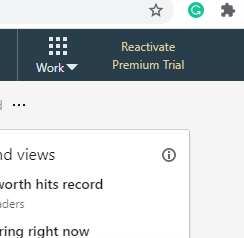
1. On the LinkedIn homepage, click the Work icon in the top right corner.

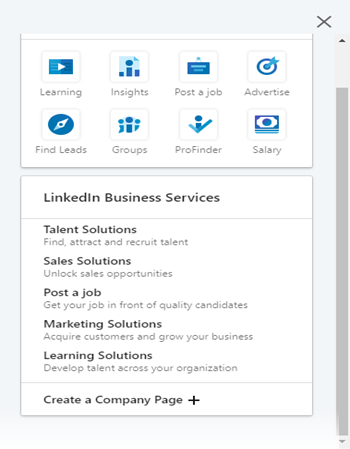
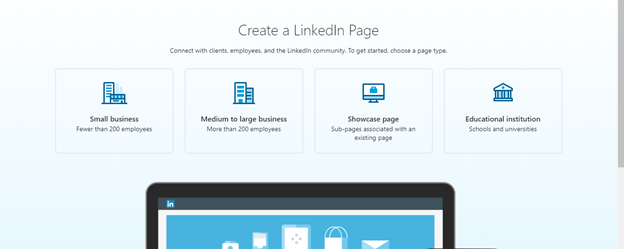
2. Select “Create a company page” and choose an option from the list that fits the page type you need for your business.

You have these choices for the business type:

  • Small business
  • Medium to large business
  • Showcase page
  • Educational institution (school or university)


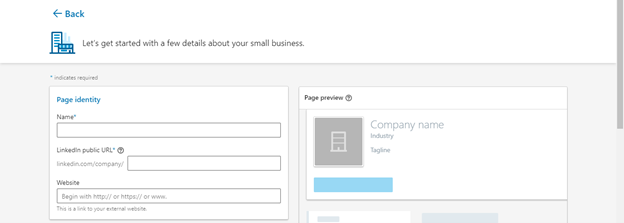
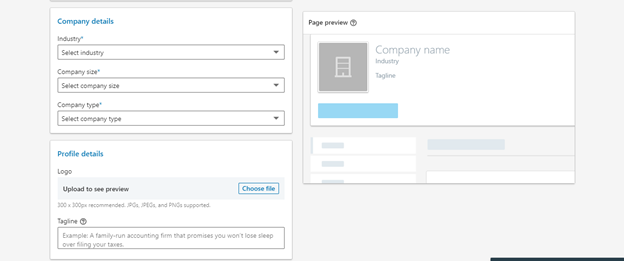
3. Fill out your page identity, company and profile details.

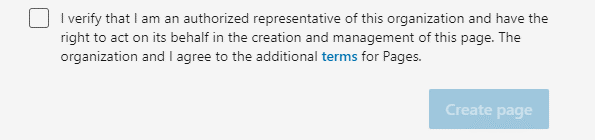
4. After you fill out all your information, check the verification box to confirm that you are allowed to operate the account on behalf of your business.

5. Select “Create page.” You may receive an error message if your company page doesn’t meet the requirements, which include having an actual company and business email. You may also be denied because you’ve exceeded your page creation limit.

6. If you do not get an error message, select “Start building your page” to customize.

Key takeaway: To set up your own LinkedIn business page, click on the Work icon and then the “create a company page” section. Fill out all the required fields to create your page and then optimize your profile with key information.

LinkedIn marketing tips to grow your business

Business News Daily got in touch with business leaders and expert marketers to find out the best way to use LinkedIn marketing to grow your business. Here’s what they had to say.

1. Find highly targeted customers and connections.

“The targeting on LinkedIn is unparalleled in the realm of digital advertising. Small businesses can zero in on the exact industry, company size and job role [of the people] that they know typically would buy their product or service. For example, if you are selling customer support software to small businesses in the United States, you can set your advertising campaigns to only be showing to businesses [that have] under 100 employees, based in America – and within that grouping, only to executives at those companies with a customer support title.” – Tim Peters, vice president of revenue operations at Doxim

2. Stay on customers’ radars.

“My company helps small businesses generate leads on LinkedIn. Clients tell us what kind of people make high-quality customers for them. We search on LinkedIn for people who fit their criteria, and then introduce them. (We do it so it looks like the client is introducing themselves, but we do all the work for them.) Then we stay in touch with the people who have expressed interest, again using LinkedIn. We do daily status updates and weekly LinkedIn blog posts to keep the client’s name in front of their network. We also send monthly emails that share information about the kinds of problems our clients can solve for their customers and share the results they have achieved for other customers. We also make offers, such as inviting people to a webinar or offering a whitepaper. The result is a simple, inexpensive, systematic process for doing lead generation, with all the work done through LinkedIn.” – Judy Schramm, CEO of ProResource Inc.

3. Grow your email marketing list.

“I highly recommend everyone on LinkedIn write a crafted letter [to each connection], saying thank you for being connected on LinkedIn, and that you invite them to be part of your email marketing list. Do apologize for the lack of personalization in the email. LinkedIn lets you message 50 people at a time this way. I added about 300 people to my email list with this method. Include in your email a direct link for the email signup. It is imperative that you have reciprocity in the message: Tell them what they will receive by signing up for the email list, and offer to look at something of theirs, which is a fairly noncommittal method to garner goodwill.” – Bradford Hines, founder ofYumDomains and HungryKids.org

4. Use sponsored updates.

“With sponsored updates, businesses pay to push their post onto an individual’s LinkedIn feed. This ‘pay-per-click’ or ‘pay-per-1,000’ impression feature offers demographics similar to other social platforms (location, gender and age), but one key differentiation is the ability to customize based on company name, job title, job function, skills, schools and groups. Users can target interested industries without competing against the noise of irrelevant companies and messages. A sponsored update can be an excellent way to promote thought-leadership content useful primarily to the targeted audience with a strong call to action. People don’t want to see pure advertising anymore and want something useful for free. By promoting a firm’s content (whitepaper, guide, etc.) through a LinkedIn Sponsored Update, a firm can target a niche audience, increase website visitors and, if the content is compelling enough, generate sales leads.” – Jeremy Durant, business principal at Bop Design

5. Post high-quality content.

“Good content can be highly targeted and should accomplish two goals. First, it should teach others how to solve a problem or how to do their job better, and it then establishes you as a thought leader in that space. Each aspect naturally leads to more business if you offer them real value. It’s basic psychology, and it gets real results.” – Michael Riley, co-founder of Boxter

6. … and go viral.

“Posting directly on LinkedIn is the most powerful tool available on LinkedIn today. If a post begins to gain some momentum, LinkedIn will put a spotlight behind it in one of their categories, and it can get tens of thousands of readers (or more). This is a great way to improve your visibility while reaching readers in a way that would not have been possible on your own website or blog or even [by] posting an article link on LinkedIn.” – Lavie Margolin, author of The LinkedIn Butterfly Effect

7. Give a face to your employees.

“Get as many of your employees as possible to create and complete their profiles on LinkedIn. These should include appropriate photos, relevant job history that includes a description of how they help your business, and professional connections. My current company is putting together a LinkedIn Day when we’ll have a photographer available to take profile photos, and we’ll help employees set up their accounts.” – Tam Frager, marketing and communications consultant

8. Join groups – and stay active.

“One tip I always share for small business owners is to join LinkedIn groups that are relevant to their target demographic. Not only is this a great way to ‘listen in’ on what your audience is talking about, there may [also] be times for small business owners to interact or offer their advice. More importantly, you can message the members of groups you are in, even if you aren’t connected. LinkedIn InMail adds up quickly, so this is a great way to save money when building relationships with potential clients.” – Lauren Covello, senior account executive at Garfield Group

9. … and create your own LinkedIn group.

“Here’s a secret sauce to find your ideal, ready-to-buy prospects right away on LinkedIn: Create your own LinkedIn group to start with. After you have your LinkedIn group set up, go out and join as many groups (LinkedIn allows you to be in 50 total) where your prospects are hanging out. The next step is to pick one of those new groups you’ve joined and start working the Members page to find prospects. Once you’re inside the group and approved as a member, click on Members, then filter the list of members further by searching for certain job titles or something else to winnow down the list to your ideal prospects, and then invite them to join your group (tip: send personalized invitations). Once these invitees join your LinkedIn group, you have all your proverbial fish in the same barrel – all your best prospects in one place! You can control this LinkedIn group so that no competitors get in, and you can share great, valuable content within the group that your prospects will love. You also get to demonstrate your value and expertise for them while avoiding overt sales pitches or spam. Plus, you also have a built-in email list, a focus group of your core prospects and clients, and so on. This is a great tactic to build your brand and generate leads to boost your small business.” – Ali Liaquat, head of marketing at IT-Serve.com

10. Make your company page matter.

“It’s also important to have an updated and consistent presence for your brand with its own company profile page. Imagery, colors and content on this page should be consistent with your website and any other social media profiles the business has. The page should be updated regularly so the brand is active and appears to be a current business. We’ve all had the experience of stumbling upon a company social media profile that’s updated once a month or, worse, hasn’t been updated in months. Creating a LinkedIn presence then not maintaining it will be worse than not having one at all.” – Carrie Booher, digital content editor at WWOZ 90.7 FM

11. Claim your custom URL.

“Everyone should claim their custom URL to ensure it includes their name. This is especially important for people who have a lot of contact with potential clients – especially for those who [are in] professional services and the B2B sector – because when meeting with someone they have not yet met, many people will search Google for the name of the person with whom they’re meeting to learn more about them. Claiming your custom URL makes it more likely your LinkedIn profile will rank at the top of those search results.” – David Erickson, principal at e-Strategy Media

12. Complete the summary section on your own profile.

“The summary section is the most overlooked. You have 2,000 characters to speak to your target audience, directly and persuasively. Use complete sentences, write in first person, and address their pain points clearly and succinctly. Many people prefer to go to LinkedIn [over] a website. Most of the time, people want to connect with the person before the product or service, and this is your opportunity to introduce yourself to prospective clients and customers. Also, include your contact information at the end of the summary section. Even though it’s elsewhere on your profile, make it easy for people to reach you.” – Susan Tabor-Kleiman, consultant, speaker and owner of Your Professional Writer

13. Think of it as a numbers game.

“I have learned that LinkedIn marketing is more science, less art. In other words, it’s a numbers game. I know that each Wednesday, I’ll touch at least 2,000 C-level executives. These touches will lead to about six responses, and two of those six will become clients. Instead of attending trade conferences, exhibiting and speaking at a cost of approximately $10,000 per conference, I have built my own practice for less than $1,000 a year for marketing, $250 of which goes to LinkedIn for a Premium account. I can afford a few hours each week of my time more than I want to swallow the $40,000-per-year pill that I know most of my colleagues spend, attending an average of four conferences each year.” – Greg Taylor, owner of Telecom Law Attorney

14. Avoid hard sells.

“Treat LinkedIn like any other form of marketing that you do and get clued up on the latest trends. People don’t want to be interrupted, so try your best to be ‘discovered’ on LinkedIn. Read up on content marketing and inbound marketing, and apply these strategies to this network. There are plenty of people acting like hard-sell 1980s sales reps on LinkedIn, so be wise and don’t become one of them.” – Nikki Hammett, global marketing manager at NashTech Ltd.

15. Start with connections, then build relationships.

“Understand that LinkedIn is a social network for professionals to connect with other professionals. A business owner can and should connect with prospects, strategic partners, referral partners, and other business owners. And once those connections are made, the business owner can decide how to nurture specific connections to grow the relationship.” – Charlene Burke, CEO of Search by Burke

Key takeaway: To use LinkedIn for marketing, put your brand out there on the platform and build connections. Provide details about your business in your profile so consumers understand your brand. Be an active participant on LinkedIn, which means joining groups, posting quality content and engaging with your connections.

Featured Posts:

How to Conduct a Market Analysis for Your Business

  A market analysis can help you identify how to better position your business to be competitive and serve your customers. A market analysis...

Popular Posts: